
Beyond Collagen: How GHK-Cu Rebuilds Aging Skin
There are hundreds of products promising younger-looking skin, and now peptides have become one of the biggest trends in skin rejuvenation. Some are worth paying attention to, and others have a lot more marketing behind them than science.
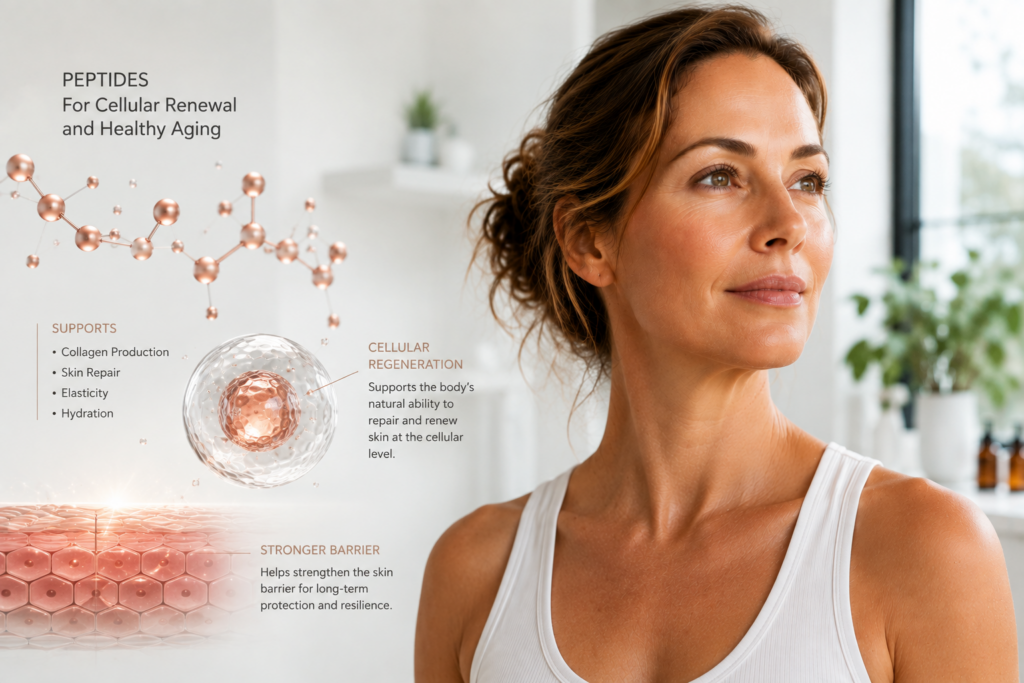
One peptide I think is particularly interesting is GHK-Cu, commonly called a copper peptide. What makes GHK-Cu different is how it works. Instead of simply moisturizing the skin or temporarily improving how it looks, GHK-Cu works with some of the natural repair processes your skin already uses. It has been studied for its ability to support collagen and elastin production, skin repair, and the remodeling of damaged tissue.
At Axios Health & Wellness, we use GHK-Cu primarily as a topical skin-remolding treatment, either on its own or as part of a skin rejuvenation plan that includes microneedling with platelet-rich plasma (PRP).
What Is GHK-Cu?
GHK-Cu sounds much more complicated than it really is. GHK is a naturally occurring peptide made from just three amino acids. Our bodies already produce it, and one of its interesting properties is its ability to bind to copper. When the two come together, we call it GHK-Cu.
GHK-Cu has been studied for decades for its role in tissue repair and skin health. One of the reasons we’re interested in it is its effect on fibroblasts, the cells in your skin responsible for producing collagen and elastin. Collagen provides strength and structure to the skin, while elastin allows it to stretch and bounce back.
As we age, we make less of both, and the collagen we already have becomes more damaged and disorganized. That contributes to the fine lines, wrinkles, thinner skin, and loss of firmness we associate with aging. GHK-Cu appears to help support the cells involved in rebuilding that structure.
GHK-Cu Does More Than Make Collagen
This is one of the reasons I like GHK-Cu. When we talk about skin rejuvenation, everyone wants to talk about making more collagen. But simply making more collagen isn’t the whole story. Your skin also needs to get rid of damaged collagen and replace it with healthier, better-organized tissue.
Think about remodeling a house. Before you rebuild an old damaged wall, you first remove the damaged material. Then you replace it and strengthen the new structure. Your skin does something similar.
GHK-Cu appears to support both sides of that process. It helps signal the cells responsible for making new collagen and elastin while also supporting the natural processes involved in clearing and remodeling damaged tissue. That is why I think skin remodeling is a better way to describe GHK-Cu than simply calling it a “collagen peptide.”
How We Use GHK-Cu at Axios:
Topical GHK-Cu Serum
One of the simplest ways we use GHK-Cu is as a topical serum applied directly to the area we’re trying to treat. Our typical protocol is daily topical use for approximately 8–12 weeks. This isn’t something I expect someone to use for three or four days and suddenly wake up with different skin. Collagen production and skin remodeling take time.
The goal is to consistently expose the skin to GHK-Cu while those remodeling processes are taking place. For patients mainly interested in improving the appearance and quality of aging skin, topical GHK-Cu can be used as a stand-alone treatment without having to undergo a procedure.
GHK-Cu After Microneedling with PRP
This is where I think GHK-Cu gets even more interesting. With microneedling with platelet-rich plasma (PRP), also known as the Vampire Facial, we intentionally create thousands of controlled micro-injuries in the skin. We then use platelet-rich plasma from your own blood as part of the treatment. Those tiny injuries essentially tell your skin, it’s time to repair and rebuild. That repair response activates the cells responsible for producing new collagen and rebuilding the skin.
We allow the skin to heal after the procedure before starting GHK-Cu. Once that initial healing has occurred, we begin applying topical GHK-Cu during the longer remodeling period. I think about the combination very simply: microneedling with PRP starts the repair process. GHK-Cu helps support the remodeling that follows.
We can use this same approach when treating scars with microneedling with PRP, also known as Vampire Scar Revision. Scar tissue can contain thick and poorly organized collagen, so our goal is not simply to make more collagen but to help remodel the existing tissue. Research suggests GHK-Cu can support new collagen production while also influencing the processes involved in breaking down and reorganizing damaged collagen. After the skin heals from scar revision with microneedling, topical GHK-Cu can be used during the weeks that follow to support continued remodeling.
What Is the GLOW Peptide Stack?
If you’ve spent time looking into peptides for skin rejuvenation, you’ve probably come across the GLOW Stack. The traditional GLOW Stack combines GHK-Cu, BPC-157, and TB-500, typically as an injectable protocol. GHK-Cu is included for its potential effects on skin and collagen remodeling, while BPC-157 and TB-500 are generally used for their potential roles in healing and tissue repair.
The idea behind combining them makes sense, but I don’t necessarily agree that all three peptides need to be injected. This is especially true for GHK-Cu. When our goal is skin rejuvenation, there is more direct human research looking at GHK-Cu applied topically to the skin than there is for injectable GHK-Cu.
At Axios Health & Wellness, we take the same basic idea behind the GLOW Stack but use the peptides differently. Our protocol uses injectable BPC-157 and TB-500 along with topical GHK-Cu. BPC-157 and TB-500 remain the injectable part of the protocol for their potential roles in healing and tissue repair, while GHK-Cu is applied directly to the skin we’re trying to remodel.
I think this is an important distinction with peptide therapy. Injectable doesn’t automatically mean better. We want to use each peptide in a way that makes sense for what we’re trying to accomplish. For GHK-Cu and skin rejuvenation, research supports topical application as a way to deliver GHK-Cu directly to the skin, which is exactly where we want it working to support healing and remodeling.
A Different Way to Think About Skin Rejuvenation
What I find most interesting about GHK-Cu is that we’re not just trying to temporarily improve how the skin looks. We’re trying to support the natural processes involved in repairing and remodeling the skin itself.
Whether we use topical GHK-Cu on its own, following microneedling with PRP for the Vampire Facial or Vampire Scar Revision, or within our modified GLOW protocol, the goal is the same: support healthier collagen, improve the remodeling of damaged tissue, and give the skin time to rebuild.
GHK-Cu isn’t going to replace good skincare, sun protection, nutrition, or other treatments that affect how our skin ages. But for patients looking for another way to support skin health and rejuvenation, I think it is one of the more interesting peptides available.
Interested in GHK-Cu or Skin Rejuvenation?
At Axios Health & Wellness, we don’t believe every patient needs the same skin treatment or peptide protocol. We look at what you’re trying to improve and then talk through which options make sense for you.
If you’re interested in topical GHK-Cu, microneedling with PRP for the Vampire Facial or Vampire Scar Revision, or our GLOW protocol, contact Axios Health & Wellness to schedule a consultation. We’ll help you understand your options and develop a treatment plan based on your skin and your goals.
About the Authors
This article was co-written by Jay Griffin, FNP-C, CRNFA, and Lacey Fisher, FNP-BC, PMHNP-BC.
Jay and Lacey are board-certified Family Nurse Practitioners and hormone optimization specialists at Axios Health & Wellness. Together, they bring decades of clinical experience in hormone replacement therapy, thyroid optimization, peptide therapy, medical weight loss, and regenerative medicine.
Their goal is to help patients better understand the science behind their health and make informed decisions through evidence-based, personalized care.
Jay Griffin, FNP-C, CRNFA
Board-Certified Family Nurse Practitioner
Hormone Optimization Specialist
Founder, Axios Health & Wellness
Lacey Fisher, FNP-BC, PMHNP-BC
Board-Certified Family Nurse Practitioner
Board-Certified Psychiatric Mental Health Nurse Practitioner
Hormone Optimization Specialist
Axios Health & Wellness
Frequently Asked Questions
What is GHK-Cu?
GHK-Cu is a naturally occurring copper-binding peptide made from three amino acids. It has been studied for its potential role in tissue repair, collagen and elastin production, and skin remodeling.
What does GHK-Cu do for aging skin?
GHK-Cu appears to support fibroblasts, the cells responsible for producing collagen and elastin. It may also help regulate the processes involved in removing damaged collagen and replacing it with healthier, better-organized tissue.
How long does topical GHK-Cu take to work?
Skin remodeling doesn’t happen overnight. At Axios Health & Wellness, our typical topical GHK-Cu protocol is used daily for approximately 8–12 weeks.
Can GHK-Cu be used after microneedling with PRP?
Yes. This is one of the ways we use GHK-Cu at Axios. We first allow the skin to heal after microneedling with PRP for the Vampire Facial and then introduce topical GHK-Cu during the remodeling period.
Can GHK-Cu be used for scars?
GHK-Cu has properties that make it interesting for scar remodeling, including its effects on collagen production and tissue remodeling. At Axios, we may use topical GHK-Cu after the skin has healed from microneedling with PRP for Vampire Scar Revision. Human research specifically proving GHK-Cu as a stand-alone scar treatment is still limited.
What is the GLOW Stack?
The traditional GLOW Stack generally combines GHK-Cu, BPC-157, and TB-500 as injectable peptides. At Axios, our approach uses topical GHK-Cu with injectable BPC-157 and TB-500, rather than automatically injecting GHK-Cu.
Is topical or injectable GHK-Cu better for skin?
There is more direct human research evaluating topical GHK-Cu for aging skin than injectable GHK-Cu. That is one reason we prefer topical GHK-Cu when our primary goal is skin rejuvenation and remodeling.
References
- Abdulghani AA, Sherr S, Shirin S, et al. Effects of topical creams containing vitamin C, a copper-binding peptide cream and melatonin compared with tretinoin. Dis Manag Clin Outcomes.
- Badenhorst T, Svirskis D, Merrilees M, et al. Effects of GHK-Cu on MMP and TIMP expression, collagen and elastin production, and facial wrinkle parameters.
- Maquart FX, Pickart L, Laurent M, et al. Stimulation of collagen synthesis in fibroblast cultures by GHK-Cu²
- Pickart L, Vasquez-Soltero JM, Margolina A. GHK peptide as a natural modulator of multiple cellular pathways in skin regeneration. BioMed Research International.