
Lost That Spark? Reigniting Desire: The Science Behind Peptide PT-141
Sexual desire can change for a lot of reasons. Hormones, stress, relationships, medications, sleep, and overall health can all play a role. But sometimes we correct the obvious problems, optimize hormones, and a patient still tells me, “I just don’t have the desire I used to have.” That is when we have to look beyond hormone levels and recognize that sexual desire is more complicated than a lab result.
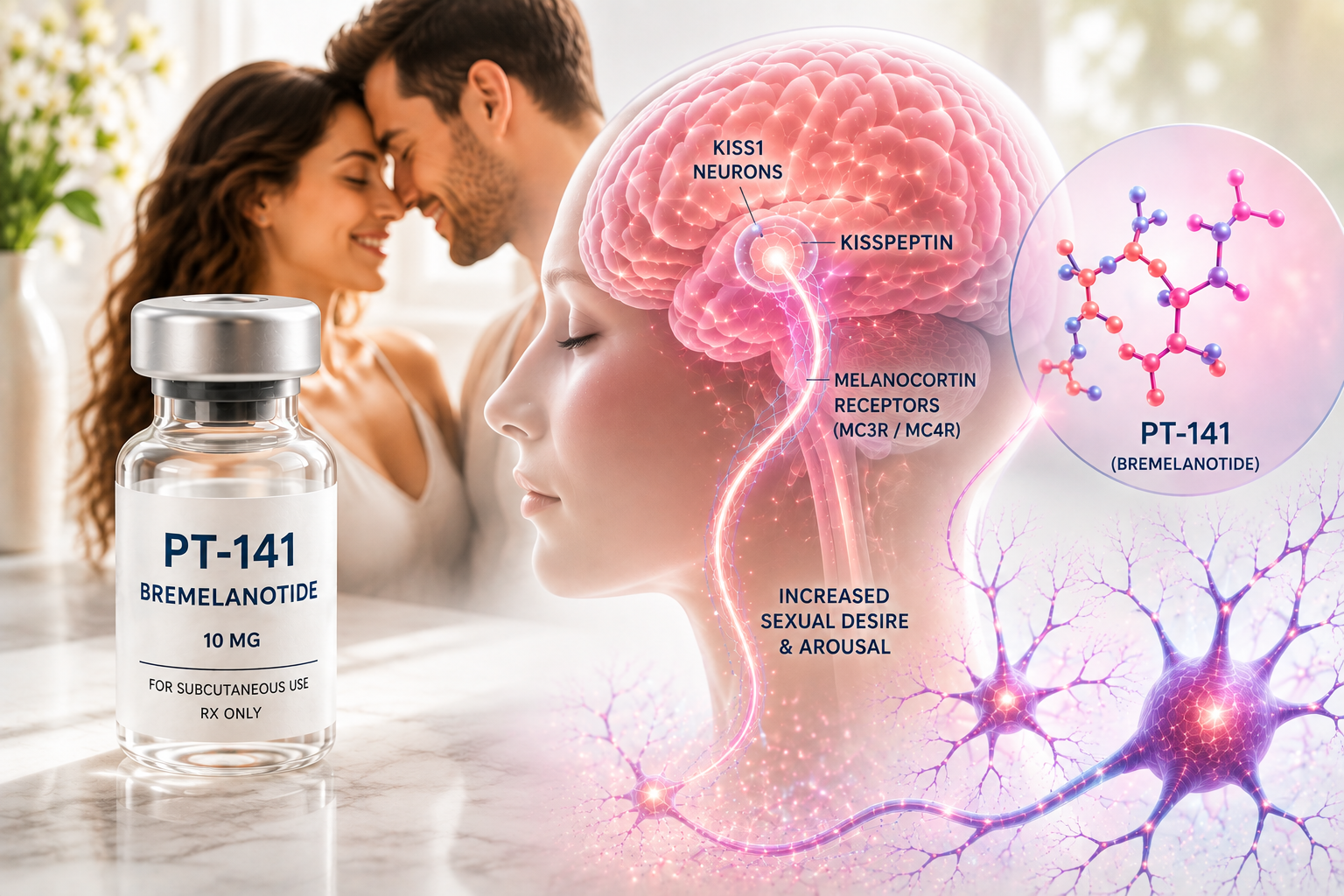
PT-141, also known as bremelanotide, is a peptide that takes a very different approach to sexual health. Instead of simply raising hormone levels or focusing on blood flow, PT-141 works through the brain, where sexual interest and arousal actually begin. That makes it especially interesting for people who feel physically capable of having sex but have lost some of the desire, excitement, or responsiveness they once had.
PT-141 isn’t meant to replace good hormone management or fix every cause of low libido. Instead, it gives us another way to approach sexual health when the problem isn’t just physical. For the right patient, targeting the desire and arousal side of the sexual response may be the missing piece.
What Is PT-141 and How Does It Work?
PT-141 is a peptide, also known as bremelanotide, that has a pretty interesting history. It wasn’t originally developed to improve sexual desire. It came from research on another peptide called Melanotan II, which was being studied for its effects on skin pigmentation. During those studies, researchers noticed an unexpected effect—increased sexual interest and arousal.
That discovery led researchers to focus specifically on the peptide’s effects on sexual response, eventually leading to PT-141. Unlike many treatments used for sexual health, PT-141 doesn’t work primarily by changing hormone levels or increasing blood flow. It works through the brain and the signaling involved in sexual desire and arousal.
More specifically, PT-141 activates a group of receptors called melanocortin receptors, particularly the MC4 receptor. We don’t need to get overly technical about the receptor itself, but it is important to understand what happens when it is activated. This system helps regulate sexual motivation, interest, and the way the brain responds to sexual cues.
One way I like to explain sexual desire is to think of the brain as having an accelerator and a brake. Certain signals help move us toward sexual interest and arousal, while others can slow that response down. Dopamine is one of the important signals associated with sexual motivation and reward. PT-141 appears to help shift that balance toward the signals that support sexual interest and arousal.
That doesn’t mean PT-141 simply creates sexual desire on command. Attraction, touch, emotional connection, stimulation, and the situation itself still matter. Instead, PT-141 may help the brain become more responsive to those sexual cues, allowing desire and arousal to build more easily when the opportunity is already there.
This is what makes PT-141 different from simply trying to raise testosterone or estrogen. Hormones are incredibly important to sexual health, and we always want to address them when they are part of the problem. But sexual desire doesn’t come from a hormone level alone. Those hormonal and sexual signals still have to be interpreted by the brain and turned into desire, excitement, and arousal. PT-141 gives us a way to target that part of the sexual response.
PT-141 for Women: When the Desire Just Isn’t There
For many women, low libido isn’t about whether they can have sex. The problem is that the desire, excitement, or interest just isn’t there anymore. This can be especially frustrating when hormones and other health concerns have been addressed, but that spark still hasn’t returned.
Women are where we have the strongest clinical research on PT-141. Bremelanotide has been studied in women with hypoactive sexual desire disorder (HSDD), where persistent low sexual desire causes personal distress. Clinical trials in certain premenopausal women with HSDD found improvements in sexual desire and reductions in the distress associated with low libido.
PT-141 isn’t expected to suddenly create an overwhelming sex drive. A better way to think about it is helping turn the desire and arousal response back up. For the woman who tells me, “I wish I felt more interested in sex, but that desire just isn’t there,” PT-141 may help make it easier for that interest and excitement to return when sexual cues are present. It can help bridge that gap between being open to intimacy and actually feeling the desire to engage in it.
PT-141 for Men: Desire and Erections Aren’t the Same Thing
For men, sexual desire and the ability to get an erection are connected, but they aren’t the same thing. A man can have normal testosterone levels and be physically capable of getting an erection but still feel like his sexual drive isn’t what it used to be. On the other hand, he may have plenty of desire but struggle with the physical erection itself.
This is where PT-141 is different from medications such as Viagra or Cialis. Those medications primarily improve blood flow to help produce and maintain an erection. PT-141 works through the brain pathways involved in sexual desire and arousal. So while a PDE5 inhibitor focuses more on the physical erection, PT-141 may be useful when sexual interest and arousal are part of the problem.
Research in men is not as extensive as it is in women, but studies have shown that PT-141 can increase sexual arousal and erectile response. For some men, the two approaches may even complement each other because they are working on different parts of sexual function—one helping the brain become sexually engaged and the other helping the body respond physically.
What Does Using PT-141 Actually Feel Like?
PT-141 is typically used as needed rather than every day, which makes it different from many other peptide therapies. It is given as a small subcutaneous injection before anticipated sexual activity. The response isn’t necessarily immediate, so timing matters. Some people begin noticing effects within 30 minutes to a few hours, and the response may last well beyond the initial dose.
What someone feels can also vary. It isn’t necessarily a sudden or uncontrollable urge to have sex. Patients may notice that they are thinking about sex more, becoming interested more easily, or responding more strongly to sexual touch and stimulation. The goal is to enhance the natural sexual response rather than make it feel forced.
The most common side effect is nausea, particularly when first starting PT-141. Flushing, headache, and temporary increases in blood pressure can also occur. Because people can respond very differently, I prefer starting conservatively and finding the lowest amount that provides benefit without creating unnecessary side effects.
The Bottom Line: Sexual Desire Is More Than Hormones
Sexual health is rarely about one hormone, one lab value, or one physical response. For some people, hormones are the missing piece. For others, everything may look good on paper, but the desire and excitement they once felt still haven’t returned. PT-141 gives us another way to approach that part of sexual health by focusing on the brain’s role in desire and arousal.
At Axios Health & Wellness, we don’t look at PT-141 as a stand-alone answer for every person with low libido. We look at the whole picture—hormones, medications, overall health, sexual function, and what has actually changed for that individual. When the desire and arousal response appears to be part of the problem, PT-141 may be one option worth considering.
Ready to Get Your Spark Back?
If your sexual desire isn’t what it used to be, you don’t have to assume it’s simply something you have to accept. Schedule a consultation with Axios Health & Wellness to talk about what’s changed, what may be contributing to it, and whether peptide PT-141 may be appropriate for you.
You can contact us at (720) 899-9400, visit us at 700 Ken Pratt Blvd., Suite 108, Longmont, CO 80501, or learn more at AxiosHealthCO.com.
About the Authors
This article was co-written by Jay Griffin, FNP-C, CRNFA, and Lacey Fisher, FNP-BC, PMHNP-BC.
Jay and Lacey are board-certified Family Nurse Practitioners and hormone optimization specialists at Axios Health & Wellness. Together, they bring decades of clinical experience in hormone replacement therapy, thyroid optimization, peptide therapy, medical weight loss, and regenerative medicine.
Their goal is to help patients better understand the science behind their health and make informed decisions through evidence-based, personalized care.
Jay Griffin, FNP-C, CRNFA
Board-Certified Family Nurse Practitioner
Hormone Optimization Specialist
Founder, Axios Health & Wellness
Lacey Fisher, FNP-BC, PMHNP-BC
Board-Certified Family Nurse Practitioner
Board-Certified Psychiatric Mental Health Nurse Practitioner
Hormone Optimization Specialist
Axios Health & Wellness
Frequently Asked Questions
How quickly does PT-141 work?
PT-141 doesn’t work at exactly the same speed for everyone. Some people may begin noticing an effect within 30 minutes to a few hours, which is why timing the dose before anticipated sexual activity is important.
Does PT-141 increase testosterone or estrogen?
No. PT-141 does not work by increasing testosterone or estrogen. It works through signaling in the brain involved in sexual desire and arousal, which is one of the reasons it may be considered even when hormone levels have already been addressed.
Can both women and men use PT-141?
PT-141 has been studied in both women and men, although the strongest clinical research is in women with low sexual desire. In men, PT-141 may also influence sexual desire and arousal, but it works differently from medications used primarily to improve erectile blood flow.
What are the most common side effects of PT-141?
The most common side effect is nausea, particularly when first using PT-141. Other possible effects include flushing, headache, and temporary increases in blood pressure. Starting conservatively can help determine how an individual responds.
Do you have to take PT-141 every day?
No. Most patients use PT-141 as needed before anticipated sexual activity rather than every day. Your provider can adjust how often you use it and your dose based on your response, side effects, and overall health.